← Terug naar blog

Je governance-platform koppelen aan BI, ERP of datawarehouse: zo werkt de Spreash® API

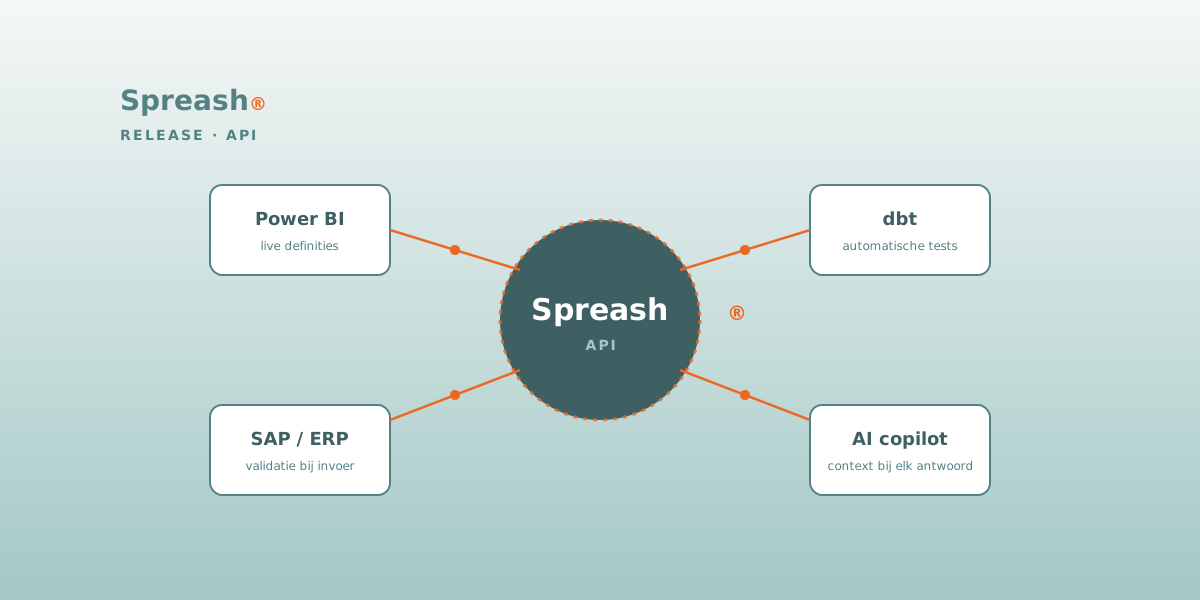
Spreash® API als centrale hub die werkafspraken doorstuurt naar Power BI, dbt, ERP en AI-copilots

Tot voor kort was Spreash® een plek waar je naartoe ging. Je legde er je blauwdruk vast, je raadpleegde definities, je bekeek wie welke bron beheerde. Met de nieuwe klant-API is dat veranderd. Spreash® komt nu naar je toe — overal waar je data werkt. In deze blog lopen we langs vier concrete use cases die klanten in de eerste weken al hebben opgezet.

Use case 1 — Power BI met live definities

De klassieke BI-discussie: wiens definitie van "actieve klant" staat eigenlijk in dit dashboard? Met de API haal je definities rechtstreeks uit Spreash® op, bijvoorbeeld als tooltip bij de KPI of als veld in de datamodellering. Verandert de definitie, dan ververst het dashboard mee. Je raakt een hele categorie "dit cijfer klopt niet"-tickets kwijt in één keer.

Een eenvoudige aanroep ziet er zo uit:

GET /api/v1/definitions/klant_actief
Authorization: Bearer <sleutel>

De response bevat de actuele definitie, de eigenaar en het moment van laatste wijziging. Precies wat je dashboard nodig heeft.

Use case 2 — dbt-tests uit je werkafspraken

Als je data engineering doet in dbt, ken je het patroon: tests zijn essentieel maar worden slecht onderhouden. De oorzaak is bijna altijd dezelfde — de test staat in code, de afspraak in iemands hoofd of in een document. Verandert de afspraak, dan vergeet iemand de test aan te passen.

De nieuwe API draait dat om. Je werkafspraken in Spreash® zijn de bron van waarheid; je dbt-tests genereer je dynamisch uit die afspraken. Een scriptje haalt bij elke pipeline-run de actuele afspraken op en zet ze om naar dbt-tests. Verandert de afspraak in Spreash®, dan verandert de test automatisch. De eigenaar van de afspraak is tegelijk de eigenaar van de test — zonder dat die het hoeft te weten.

Benieuwd wat dit jouw organisatie oplevert?

Onze rekentool geeft in twee minuten een indicatie op basis van jouw organisatiegrootte en branche.

Use case 3 — ERP of CRM dat eigen veldwaarden valideert

Bij een van onze klanten draait er sinds kort een integratie tussen Spreash® en SAP waarbij elke nieuwe productregistratie bij SAP eerst tegen de werkafspraken in Spreash® wordt gevalideerd. Mist de verplichte categorie? Komt de prijs uit een valuta die niet in de value-list staat? Dan weet de medewerker het op het moment van invoeren, niet twee weken later tijdens een auditcontrole.

Dit is het soort koppeling waar je governance tastbaar wordt. Niet iets wat achteraf een rapport genereert, maar iets wat vóór invoeren al bijstuurt. Je ziet het terug in de kwaliteitscurves.

Use case 4 — AI-assistent die jouw definities kent

De use case waar iedereen op zit te wachten. Een AI-copilot die weet wat er in jouw organisatie onder een klant wordt verstaan, wie de eigenaar is van een bepaald proces, en welke bronnen daarover meepraten. Niet omdat de prompt het toevallig weet, maar omdat de context via de API uit Spreash® komt.

Praktisch: je bouwt een context-laag die voor elke AI-vraag de relevante definities en afspraken uit Spreash® ophaalt en meegeeft als systeemcontext. De assistent raadt niet meer — hij weet. En als de afspraak verandert, verandert het antwoord mee.

Technisch kort

De API is RESTful, authentiseert op persoonlijke sleutels (per gebruiker aangemaakt via het profielmenu) of accountniveau-sleutels met rechten als een groep. Je krijgt definities, afspraakgroepen, werkafspraken, velden, rollen en objecten. Elk endpoint respecteert de rechten van de sleutel — gebruikers zien alleen wat ze in de UI ook mogen zien.

Probeer de API in je testomgeving

De API is standaard beschikbaar in je sandbox — geen add-on nodig om uit te proberen. Vraag een gratis testomgeving aan en ga los.

← Back to blog

Connecting your governance platform to BI, ERP or data warehouse: how the Spreash® API works

Spreash® API as the central hub pushing working agreements to Power BI, dbt, ERP and AI copilots

Until recently, Spreash® was a place you went to. You captured your blueprint there, looked up definitions, checked who owned which source. The new customer API changes that. Spreash® now comes to you — wherever your data works. In this post we walk through four concrete use cases customers already set up in the first weeks.

Use case 1 — Power BI with live definitions

The classic BI argument: whose definition of "active customer" is actually in this dashboard? With the API you pull definitions directly from Spreash®, for example as a KPI tooltip or as a field in your data model. Change the definition and the dashboard refreshes along with it. A whole category of "these numbers are wrong" tickets vanishes overnight.

A simple call looks like this:

GET /api/v1/definitions/active_customer
Authorization: Bearer <key>

The response contains the current definition, the owner, and the last modified timestamp. Exactly what your dashboard needs.

Use case 2 — dbt tests from your working agreements

If you do data engineering in dbt, you know the pattern: tests are essential but poorly maintained. The cause is almost always the same — the test is in code, the agreement in someone's head or a document. Change the agreement, and someone forgets to update the test.

The new API flips that. Your working agreements in Spreash® are the source of truth; your dbt tests are generated dynamically from those agreements. A small script pulls the current agreements on every pipeline run and turns them into dbt tests. Change the agreement in Spreash®, and the test changes automatically. The owner of the agreement is also the owner of the test — without ever needing to know.

Curious what this delivers for your organization?

Our calculator gives you an estimate in two minutes, based on your organization's size and industry.

Use case 3 — ERP or CRM validating its own field values

At one of our customers, an integration between Spreash® and SAP now checks every new product registration against the working agreements in Spreash® at entry time. Missing mandatory category? Currency not in the value list? The employee knows while entering the data, not two weeks later during an audit.

This is where governance becomes tangible. Not something that generates a report after the fact, but something that steers before input happens. You see it back in the quality curves.

Use case 4 — An AI assistant that knows your definitions

The use case everyone's been waiting for. An AI copilot that knows what your organization means by a customer, who owns a specific process, and which sources feed into it. Not because the prompt happens to know, but because the context comes from Spreash® via the API.

Practically: you build a context layer that for every AI query pulls the relevant definitions and agreements from Spreash® and passes them as system context. The assistant stops guessing — it knows. And when the agreement changes, the answer changes with it.

Technical in brief

The API is RESTful and authenticates via personal keys (created per user from the profile menu) or account-level keys with permissions like a group. You get definitions, agreement sets, working agreements, fields, roles and objects. Every endpoint respects the key's permissions — users only see what they'd see in the UI.

Try the API in your test environment

The API is available by default in your sandbox — no add-on needed to try it. Request a free test environment and dive in.