← Terug naar blog

Wat we leerden tijdens het webinar: datacontext als fundament voor AI

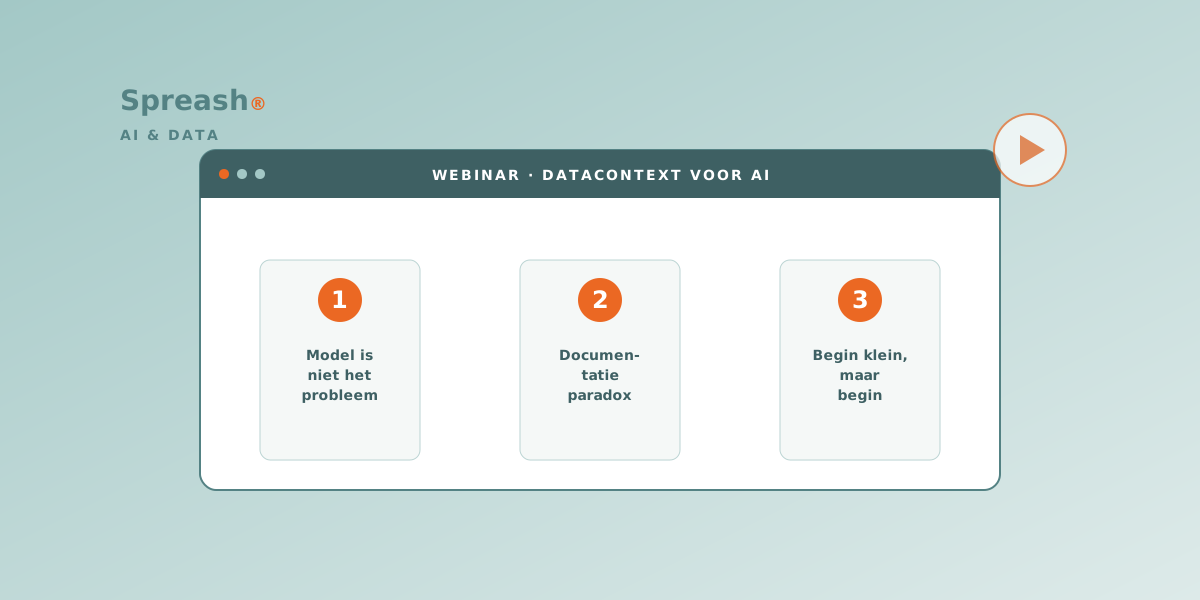
Webinar over datacontext als fundament voor AI, gepresenteerd door Spreash®

Vorige week donderdag organiseerden we een webinar over datacontext als fundament voor AI. Een half uur, een flinke zaal online, en een Q&A die nog een kwartier extra uitliep. Dat laatste vooral omdat de vragen zo herkenbaar waren — iedereen zit met hetzelfde probleem, bijna niemand heeft er al een oplossing voor. Hier zijn de drie inzichten die het sterkst binnenkwamen.

Inzicht 1 — AI-projecten stranden zelden op het model

De eerste poll leverde het antwoord dat we verwachtten. Meer dan driekwart van de deelnemers gaf aan dat hun AI-pilots vast kwamen te zitten op datakwaliteit of context, niet op modelkeuze of prompt engineering. Dat is geen nieuws voor wie een jaar in het veld staat, maar het is wel nieuws voor organisaties die nog verwachten dat een duurdere LLM of een extra prompt-laag het probleem oplost. Dat gebeurt niet. De bottleneck zit onder het model.

Inzicht 2 — De documentatieparadox

Een van de krachtigste observaties kwam uit de Q&A. Een deelnemer vatte het samen: "We hebben een datacatalogus. We hebben een glossarium. We hebben een governance-board. En toch weten mensen nog steeds niet wat een klant is." Herkenbaar, en het laat precies zien waarom documentatie faalt. Het is passief, het veroudert onzichtbaar, en het staat los van de systemen waar het over gaat. Een werkafspraak is iets anders: een regel die zichzelf controleert en zich meldt op het moment dat de werkelijkheid eromheen schuift.

Benieuwd wat dit jouw organisatie kost?

Onze rekentool geeft in twee minuten een indicatie op basis van jouw organisatiegrootte en branche.

Inzicht 3 — Begin klein, maar begin wel

Het meest praktische advies dat we deelden: start met vijf werkafspraken in één domein. Niet vijftig. Niet "we leggen de hele organisatie vast". Vijf. De reden is dat momentum belangrijker is dan volledigheid. Zodra de eerste werkafspraak binnen een week een echte afwijking signaleert en voorkomt, komt de rest vanzelf. Elke organisatie die probeert in één groot project alles tegelijk te doen, komt maanden later nog niet in productie. Elke organisatie die klein begint, zit binnen een kwartaal op twintig afspraken.

De vragen die bleven hangen

Drie vragen uit de Q&A waar we niet volledig aan toekwamen:

  • Hoe ga je om met bestaande documentatie? Kort antwoord: laat hem staan tot je dezelfde afspraak als werkafspraak hebt vastgelegd. Haal hem dan weg — twee plekken is één te veel.
  • Wie wordt eigenaar van een werkafspraak? De persoon die eindverantwoordelijk is voor het domein waar de afspraak over gaat. Niet IT, niet de datasteward, maar de business.
  • Hoe koppel je dit aan AI-tooling? Via de klant-API haal je definities en afspraken live op in je eigen stack. Daar schrijven we binnenkort een aparte diepgaande blog over.

Gemist? Vraag de opname op

Of ga direct zelf aan de slag. Vraag een gratis testomgeving aan — binnen 1 werkdag staat je omgeving klaar.

← Back to blog

What we learned at the webinar: data context as the foundation for AI

Webinar on data context as the foundation for AI, presented by Spreash®

Last Thursday we hosted a webinar on data context as the foundation for AI. Half an hour, a solid online crowd, and a Q&A that ran over by fifteen minutes. That last part mostly because the questions were so recognizable — everyone has the same problem, almost nobody has a solution yet. Here are the three insights that landed hardest.

Insight 1 — AI projects rarely fail on the model

The first poll gave us the answer we expected. More than three-quarters of attendees said their AI pilots were stuck on data quality or context, not on model choice or prompt engineering. That's old news if you've been in the field for a year, but it's news to organizations still hoping a more expensive LLM or an extra prompt layer will solve it. It won't. The bottleneck sits below the model.

Insight 2 — The documentation paradox

One of the sharpest observations came from the Q&A. An attendee put it this way: "We have a data catalog. We have a glossary. We have a governance board. And people still don't know what a customer is." Familiar — and it shows exactly why documentation fails. It's passive, it ages invisibly, and it sits apart from the systems it describes. A working agreement is something else: a rule that checks itself and raises its hand the moment reality around it shifts.

Curious what this costs your organization?

Our calculator gives you an estimate in two minutes, based on your organization's size and industry.

Insight 3 — Start small, but start

The most practical advice we shared: start with five working agreements in one domain. Not fifty. Not "let's capture the whole organization". Five. Because momentum beats completeness. The moment your first working agreement catches a real deviation within a week, the rest follows naturally. Every organization trying to tackle everything in one big project is still not in production months later. Every organization that starts small is at twenty agreements within a quarter.

The questions that stayed with us

Three questions from the Q&A we didn't fully get to:

  • How do you deal with existing documentation? Short answer: leave it until you've captured the same agreement as a working agreement. Then remove the old one — two places is one too many.
  • Who owns a working agreement? The person ultimately responsible for the domain the agreement covers. Not IT, not the data steward — the business.
  • How do you connect this to AI tooling? Through the customer API you pull definitions and agreements into your own stack live. We'll write a dedicated deep-dive on this soon.

Missed it? Request the recording

Or get started yourself. Request a free test environment — ready within 1 business day.